by Arlene
I like mystery novels, especially a good murder mystery. When you give me a murder mystery written by a woman, you have my attention. When that woman is Agatha Christie, I know I will love it.
For various reasons I have had the time to read more these past few months ( I will come back to the reasons for this in anothe blog post, I promise).
What I have been reading is Agatha Christie novels. They are clever, well written, romantically period based – when you read them in 2020 anyway – and although I have read many in the past, and watched countless TV and film adaptations, they always stay intriguing. Added to this the comfort of a story that seems like an old friend, they are my ‘go-to’ bed side table reading when I want a good murder mystery.
Marple
I particularly like the Miss Marple, rather than the Hercule Poirot novels. I have not closely examined why that is the case, but I feel sure it is because not only do I identify with Miss Marple, but because I very much do not identify with Poirot, or the sheer maleness of the characters. I hasten to add here that I am not an elderly spinster who solves crimes, (not yet anyway, but I’m sure my time will come), any more than am I a retired Belgian police officer.
Poirot
I enjoy the Poirot stories, but I often find the female characters two dimensional, certainly because they were always seen, and reported, through the male point of view. Self-centred and egotistical, Poirot irritates me long before I am half way through the book. This isn’t the blog post to deal with women and the male gaze, but I am sure this is the reason I cannot really connect with the Poirot mysteries.
Characters
The fact that the novels are actually written by a woman, says so much about the time Christie was living in. Her experience of how women were seen, thought of, and treated, seep into how she writes the male characters, and talks of her lived experience in a way that would take books worth of research. This isn’t the blog post for that either you will be relieved to hear.
Marple on the other hand, I completely get. Largely ignored by many of the characters she interacts with, she is able to solve many of the crimes by being a good observer of human nature. Her age renders her completely invisible to the male characters (ok, maybe this is the blog post to deal with the male gaze after all?).
Far from being sweet and fluffy, Marple is shrewd, observant, and always expects the worst of people. What a great disguise, not being sexually interesting is! As I get older, this gift is being bestowed upon me by the society I live in. The joys of being a middle aged, menopausal woman are many. Now back to the books…
The mystery
It is easy to see why the appeal of Christie’s novels has endured. The murder, which at first seems perplexing, is slowly and systematically picked apart, and the murderer revealed. The reader is usually introduced to the information at the same time as the characters – not always, although this is often just the supporting evidence – and part of the thrill lies in seeing if you can work out not only who the murderer is, but how and why they committed the crime before the detective reveals all. That’s the thrill for me anyway, and with not only Poirot and Marple, but Tommy and Tuppence Beresford, Parker Pyne and Harley Quin stories, there is plenty to read.
Christie’s Life
But it’s not just the books I like, I am intrigued by much of Christies own life. She was a writer, play-write, traveller, daughter, mother, wife and surfer. Yes, surfer, look it up.
If you want to know more about Agatha Christie, I recommend the website https://www.agathachristie.com/, which has information on her writing, life and legacy.
She wrote from an early age, was close to her mother and her own daughter in turn. She had two husbands, volunteered and worked through two world wars, encountered death, illness, grief and depression, and still wrote some of the best known, and best loved mystery novels of all time. The more I find out about her, the more there seems to know.
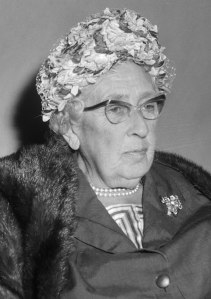
Born in 1890, and dying in 1976 at the age of 86, she will have experienced the huge changes in world view brought about by wars, suffrage, rock and roll, the women’s rights movement, the space race, the cold war, Britain joining the EU and decimalisation of currency. She saw Queen Victoria succeeded by King Edward VII, who was then succeeded by George V, Edward VIII, George Vl and finally Queen Elizabeth II. And she really knew how to wear a hat.

 Mainly Witterings